Trees planted is an input, not an outcome. A plantation reported as 50,000 trees may have a survival rate nobody measured. Here's how to build CSR plantation reporting around verifiable outcomes instead of planting-day counts.
WRITTEN BY
O
Siddharth Kothari
Managing Director
TAGS
CSR plantation impact reporting
tree plantation CSR measurement
CSR environmental impact assessment
plantation survival tracking
corporate tree planting verification
Corporate plantation programmes almost universally report the same headline metric: trees planted. It is a clean, large number, and it is measured on the one day when no environmental benefit has yet occurred. Whether those trees are alive a year later, and what they are actually sequestering, is frequently unknown to the organisation funding them.
The Gap Between Planting and Impact
Planting is an input. Impact accrues over years, and only from trees that survive and grow. Survival rates across plantation projects vary widely depending on species suitability to the site, planting technique, and — most decisively — whether anyone was responsible for aftercare through the first few dry seasons.
This creates an uncomfortable situation for CSR reporting. Two projects with identical planting figures and identical budgets can produce substantially different environmental outcomes, and conventional reporting cannot distinguish them. Worse, the project with worse outcomes is often indistinguishable in the annual report from the one that worked.
Trees planted is recorded before any environmental outcome exists
Survival is what converts planting into impact, and it is rarely measured after the first year
Species composition determines carbon sequestration rate and ecological value, but is often unreported
Aftercare through early dry seasons is the strongest determinant of survival and the least funded element
Without location-level records, a claim of 50,000 trees cannot be independently checked at all
What Verifiable Measurement Looks Like
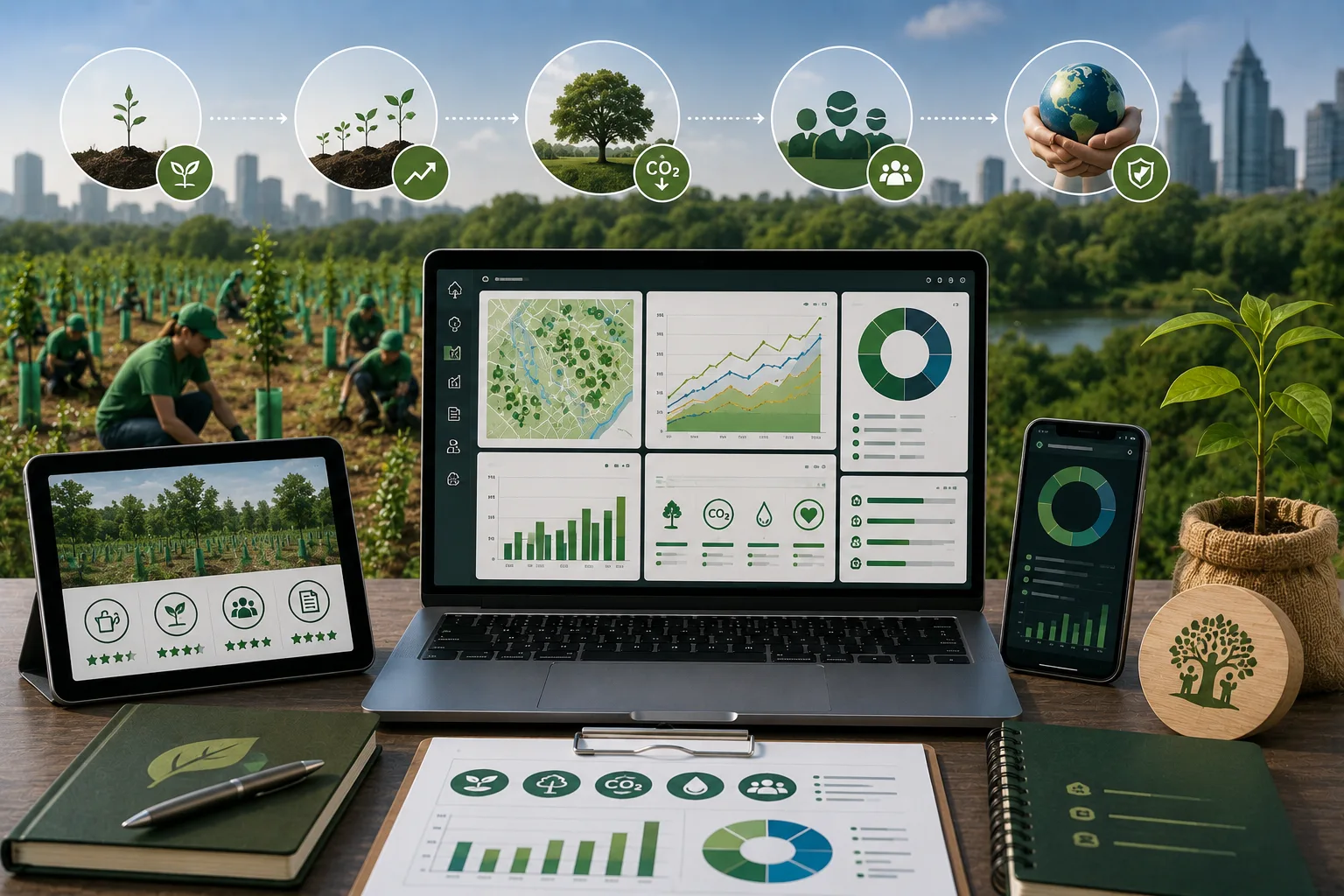
The shift is from aggregate counting to individual tracking. Each tree is geotagged at planting with its precise location, species and date, becoming a record that can be revisited rather than a unit in a total.
1Geotag at planting — GPS location, species, date, and typically a photograph, captured through a mobile app by the planting team
2Define the project boundary geospatially, so area-based calculations and subsequent remote monitoring have a fixed reference
3Re-verify at intervals — field visits for smaller sites, or drone and satellite imagery with AI tree detection for larger areas
4Measure growth, not just presence — height, canopy diameter and crown area, which is what drives biomass and carbon estimates
5Convert to environmental value using species-specific allometric models, stating the methodology used
6Monitor for reversal — fire, disease, grazing damage or clearing, which can undo accumulated benefit
State the method alongside every number
A survival rate of 82% means nothing without knowing how it was established. Sampled from a few plots and extrapolated? Verified across every geotagged location? Estimated by the implementing partner? The method determines whether the figure is auditable, and an unstated method invites the assumption that it was the weakest option available.
Why This Is Becoming a Reporting Requirement
Two pressures are pushing CSR plantation reporting towards verifiable measurement. Sustainability disclosure frameworks increasingly expect environmental claims to be substantiated rather than asserted, and the general tightening of scrutiny around unsupported environmental claims makes tree-count reporting a reputational exposure rather than a safe default.
The second pressure is internal. Once a CSR committee sees survival data, budget allocation changes. Money moves from maximising planting volume towards species selection and aftercare, because that is visibly where outcomes are determined. Organisations that measure tend to plant fewer trees and grow more of them.
Building the Report Backwards From the Claim
A practical way to design plantation reporting is to write the claim you eventually want to make, then work out what evidence would substantiate it. If the intended claim is that a programme sequestered a stated quantity of carbon, the evidence chain needs geotagged locations, verified survival, growth measurements and a stated conversion methodology. If that chain is not being captured from day one, the claim will not be defensible later.
This is the same discipline that underpins formal carbon crediting, applied at CSR scale. The requirements are lighter, but the logic is identical — see how plantation geotagging works for the verification mechanics in more depth.
Common Questions About CSR Plantation Impact Reporting
Why isn't tree count enough?
It measures an activity on planting day, before any environmental benefit exists. Survival and growth determine actual impact, and they vary widely between projects reporting identical planting numbers.
How is survival measured credibly?
By geotagging each tree at planting and re-verifying those specific locations over time, either through field visits or drone and satellite imagery with AI tree detection.
Does measuring cost more?
Monitoring adds cost, but revealing which species and sites work usually improves cost per surviving tree by redirecting budget from planting volume to aftercare.
Building Plantation Reporting You Can Defend
The test is simple: could an independent reviewer check your plantation claim? If the underlying record is a total with no locations, the answer is no. We build plantation monitoring and environmental asset platforms as part of our software development services, and GeoTree is the system we have already shipped for exactly this. If you run a CSR plantation programme and want survival and carbon figures that hold up, reach us at info@optatechinnovation.com.
Ready to build something great?
Talk to Optatech — Jaipur's AI and software development company. Free 30-minute discovery call, no obligation.